Moody
Designing a Multi-User Smart TV Ecosystem A hardware-software UX ecosystem redesigning domestic TV architecture into a collaborative hub for cohabiting couples. Collaborated on the end-to-end product design process—spanning ethnographic field research, co-design, and ergonomic testing to iterative hardware-software prototyping and multi-method usability evaluations. The resulting high-fidelity system outperformed market baselines in usability and emotional engagement.
Year
2026
Client
Politecnico di Milano
Category
Physical & Digital Products
Scope
Dual-Hardware Prototyping, Ergonomic Testing, OS Information Architecture, Cross-Device Ecosystem, Usability Testing
Personal Contributions
UX/UI, UX Research, Project Manegement, Visual Communication
Impact
Achieved a 79.0 SUS score (+19.5 vs. Amazon Fire TV baseline), a 77.5% PrEmo positive emotional rating, and 0-error task success across core flows.
The Challenge
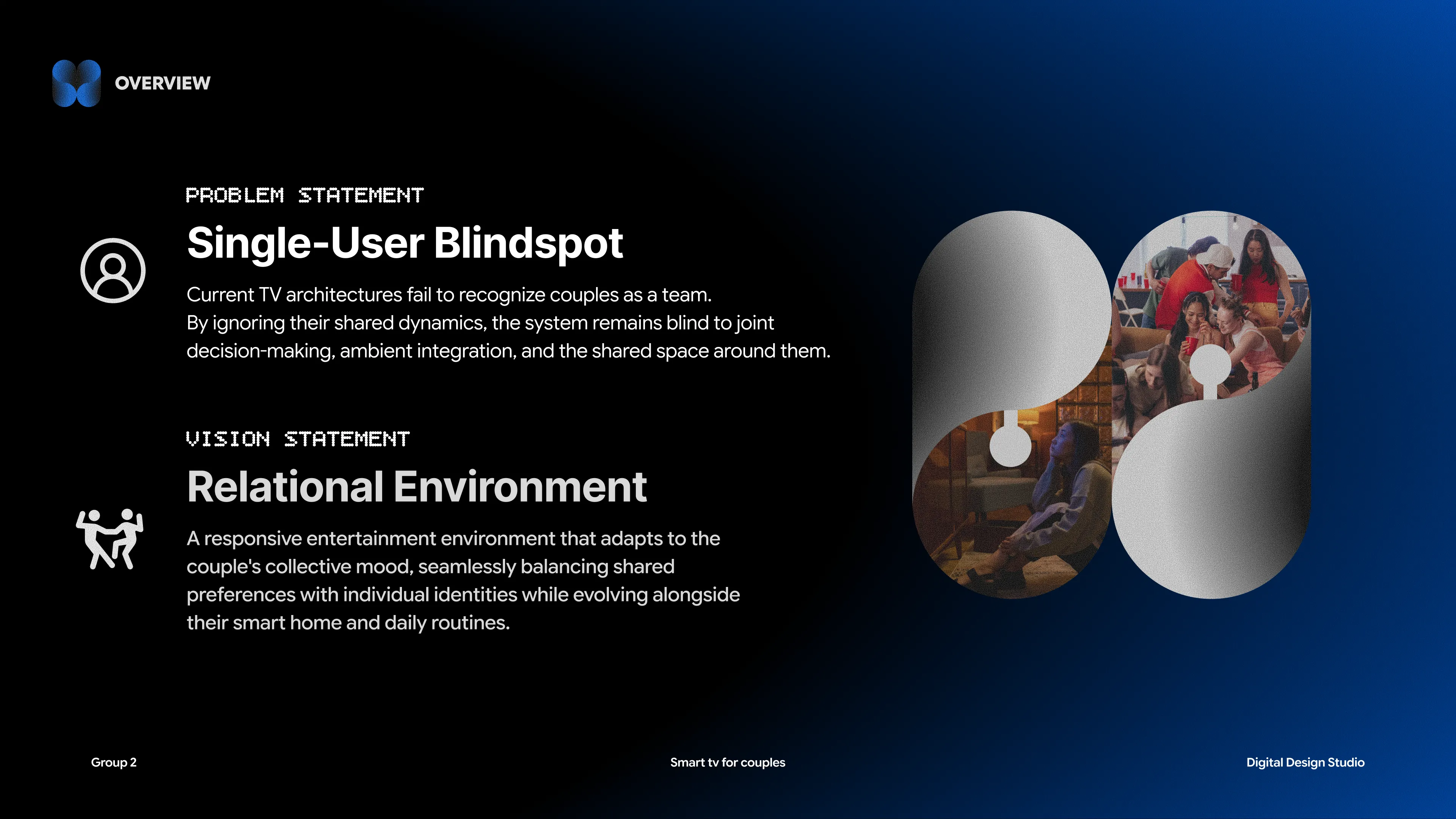
Every layer of the modern Smart TV ecosystem—from recommendation algorithms to the physical remote—is designed for a single individual. However, television viewing is the primary shared daily activity for cohabiting couples. This creates friction, asymmetric control, content negotiation deadlocks, and system blindness to group dynamics during shared household rituals.
The Solution
Moody is a holistic Smart TV ecosystem engineered around the couple as the primary user unit. Combining a dual-layer profile architecture with a tactile, disc-shaped remote control, Moody balances individual preferences, resolves content negotiation through gamified mechanics, and seamlessly transitions the TV from an active entertainment screen into a contextual background hub for cooking, dining, and hosting.
3 Big Takeaways
Dual-Layer Profiles & Collaborative Mechanics: Moody replaces single-user authentication with individual profiles that automatically blend into a shared "Duo" layer, eliminating choice paralysis through joint recommendations ("Duo Mix"), live delivery polling, and playful interactive mechanics ("Decision Game" and "Dual-Pointer Selection").
Ergonomic Surface-Resting Hardware: Grounded in field observations showing remotes spend most of their lifespans resting on furniture, the 76 mm disc-shaped remote features a concave thumb-rest, a blind-orientation lateral power button, an ambidextrous capacitive volume edge-dial, and dual-remote pointer navigation.
Contextual TV Modes Over Single-Screen TV: Testing invalidated traditional "productivity" home hubs in favor of low-prominence, ambient modes (Social Mode and AI-assisted Kitchen Hub) that embed quick smart-home presets directly into a split-screen sidebar, validated by a System Usability Scale (SUS) score jump from 59.5 (Fire TV baseline) to 79.0.

Key Research Insights
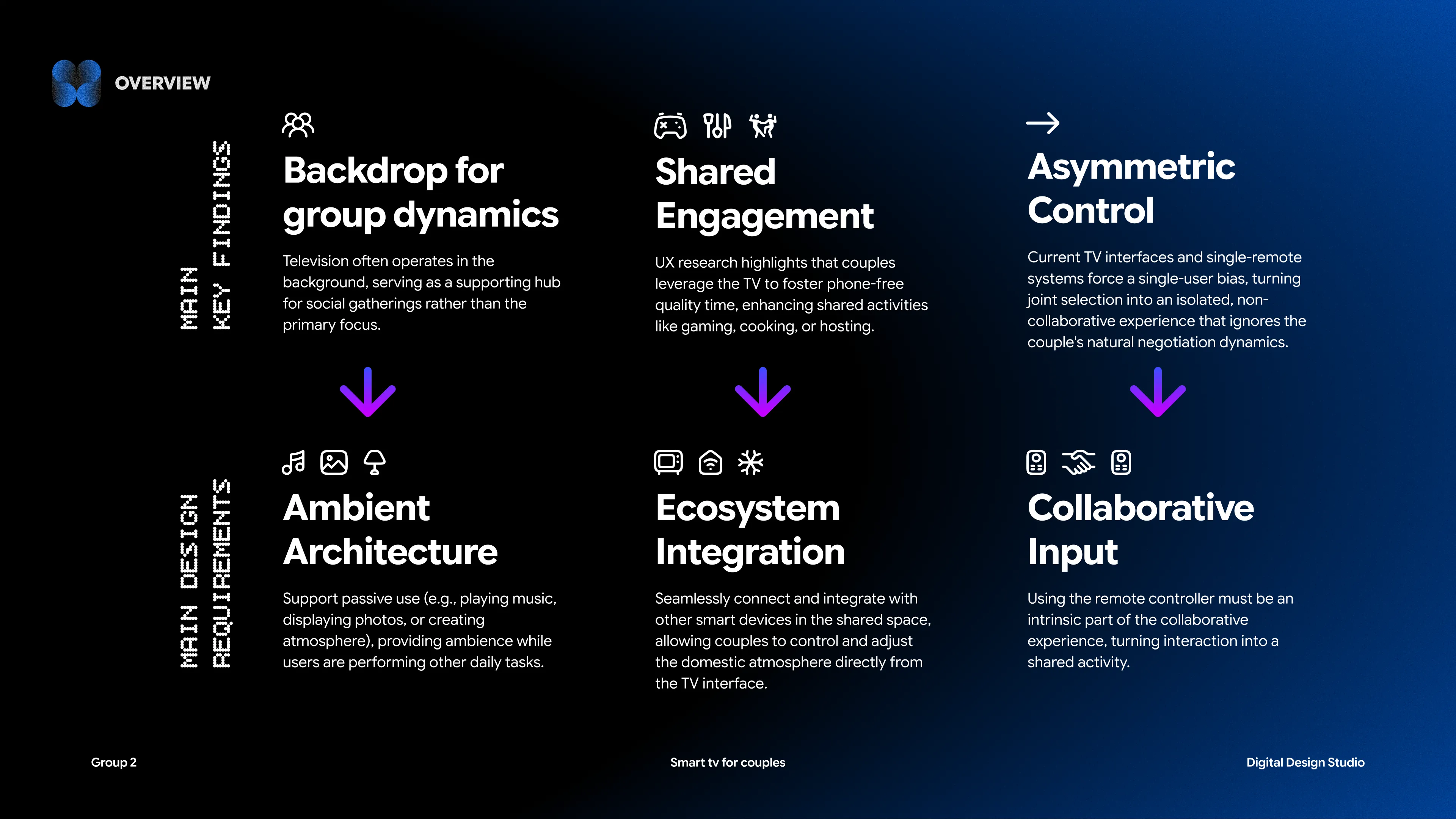
The Single-User Blindspot: Television is the primary daily activity shared by young cohabiting couples (averaging 50 daily minutes of joint viewing). However, the entire current architecture of Smart TV systems—from recommendation logic to the remote control—is designed for a single individual at a time, ignoring the pair's decision-making and negotiation dynamics.
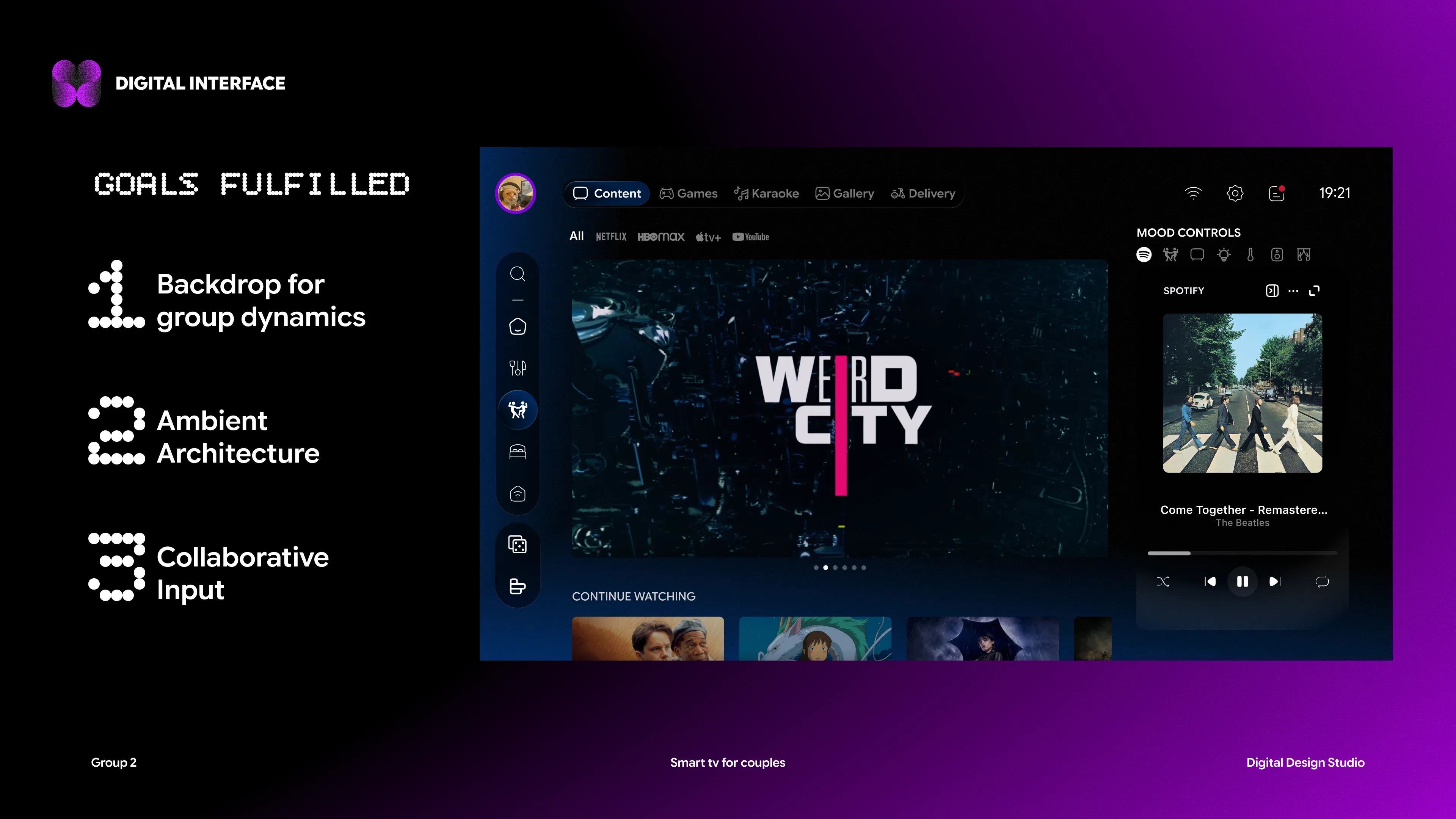
Backdrop for Group Dynamics: During social and togetherness moments (such as cooking, dining, or hosting friends), the TV frequently operates in the background, serving as an atmospheric support hub (music, photos, lighting) rather than the primary focus of attention.
Asymmetric Control and Frustration: Traditional interfaces and single-remote navigation foster an individualistic bias ("remote keeper"), transforming content selection into an isolated process or causing choice paralysis.
Mealtime Rituals and Fragmentation: Eating on the couch is the central ritual shared by the couple. Simultaneously, there is technological fragmentation, where couples use mobile devices for short-form content and switch to the TV for long-form experiences and phone-free quality time.
Trade-offs & System Prioritization
Home Hub Deprioritization: The initial hypothesis of integrating productivity features into the home screen was rejected by users during concept testing. Tools like calendars and reminders were perceived as "work-focused," leading to their complete removal from the TV hub to preserve a relaxing environment.
TV Modes Requirement Matrix (Screen Prominence):
Social Mode & Kitchen Hub (High Priority): Focused on scenarios with low TV prominence (cooking, hosting friends). Identified as high-value innovative areas and key market differentiators.
Cinema & Play (Low Priority): High-prominence scenarios with traditional immersion. Deprioritized during prototyping due to their similarity to standard Smart TV usage.
Bed Mode (Conceptual): Retained in the conceptual relaxation architecture, with practical features (such as blue light filters and sleep timers) absorbed directly into Social Mode.
Dedicated Smart Home Hub vs. Contextual Ambient Actions: The idea of an isolated Smart Home menu/hub was abandoned after mid-fi testing revealed users need to adjust lights and temperature contextually during TV modes. Ambient controls were migrated as quick presets directly into the TV Modes sidebar.
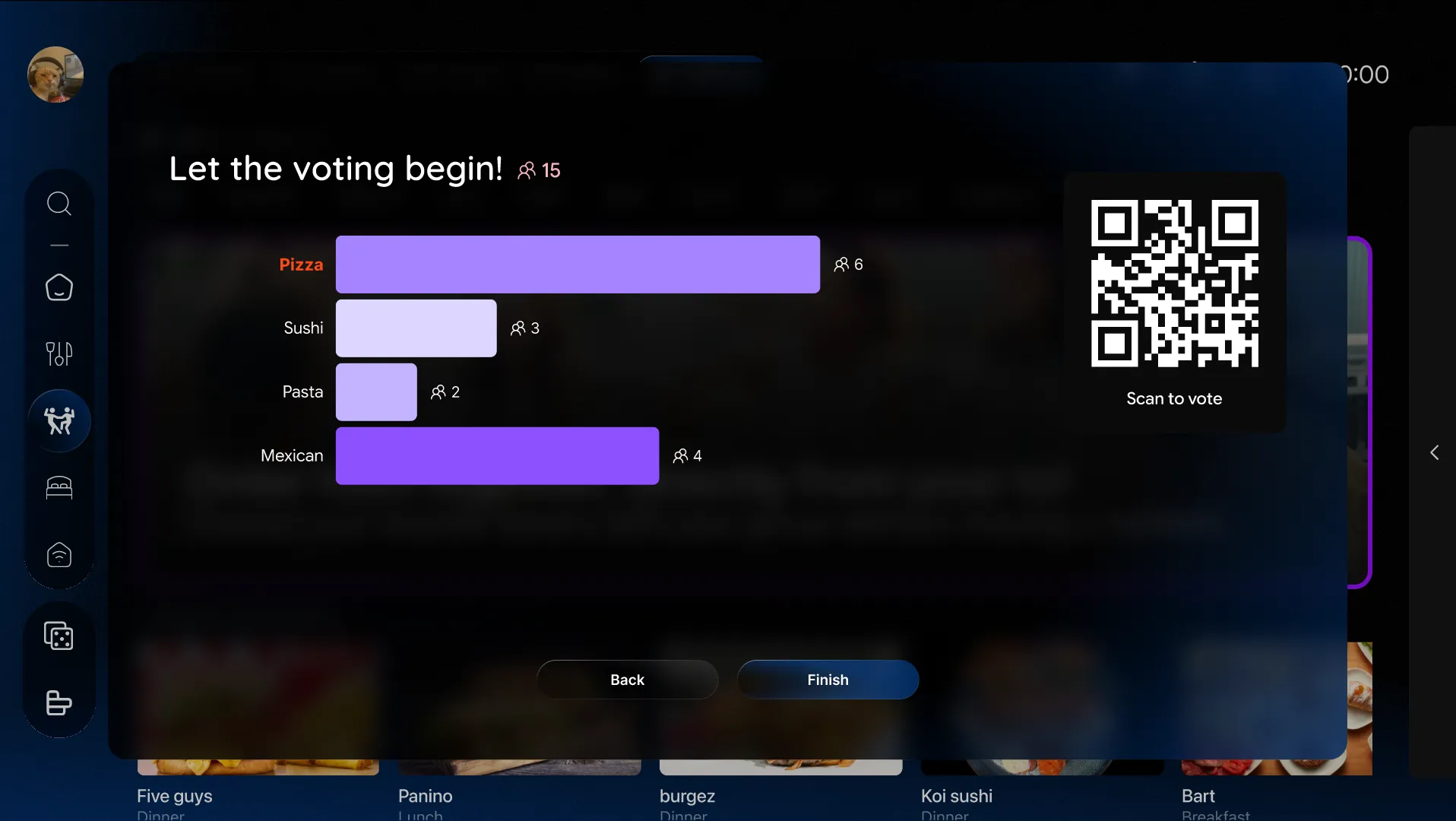
Collaborative Decision Mechanics (Delivery Polls & Decision Game): To eliminate choice paralysis and negotiation friction, the system nudges shared decision-making features over traditional single-user browsing. Group food delivery was integrated directly into the OS using live interactive polls, while content selection bottlenecks were resolved through a gamified decision mechanism ("Decision Game") that balances individual preferences into a quick, consensus-driven choice.
Iterative Ergonomics & Hardware-Software Testing
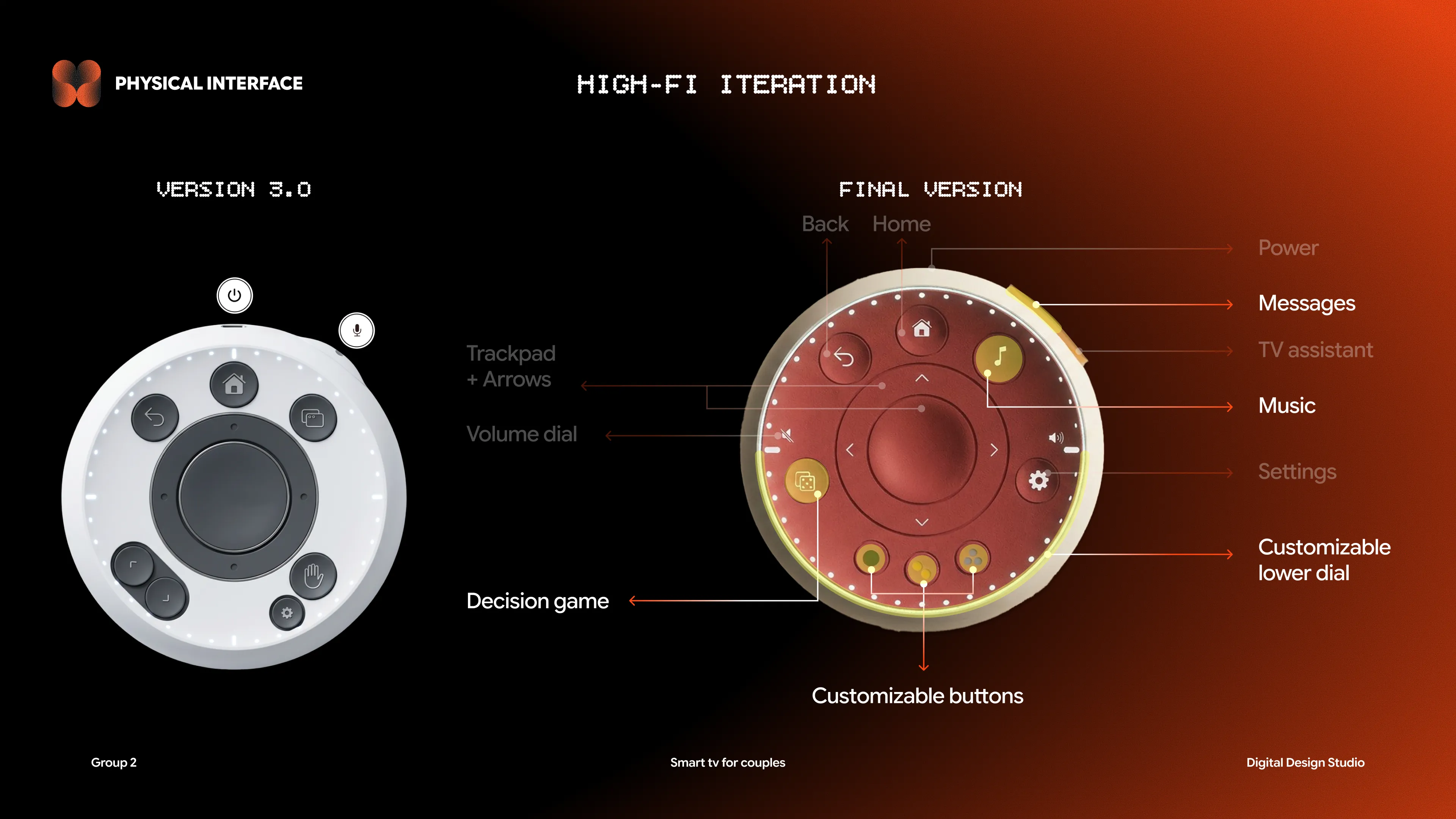
Disc Shape vs. Rectangular Geometry: Field observations showed that the remote control spends most of its lifespan resting on surfaces (couch or table). The disc shape (76 mm diameter) was chosen to provide excellent usability both handheld and operated while resting on a table, alongside ambidextrous usability.
Ergonomic Evolution and Button Reduction:
Lo-Fi to Hi-Fi: Diameter reduction to 76 mm, thickness reduction to 33 mm, rounded bottom base with a bottom grip recess for drop resistance and cushion stability, and introduction of a concave top surface with an LED volume matrix. This concavity creates a natural thumb rest and prevents accidental presses when someone sits on the remote.
Blind Orientation: The Power button was moved to the outer lateral profile, serving as a tactile reference point to orient the remote in the dark without looking.
Dial Volume Control: Transitioned from buttons/sliders to a capacitive dial on the curved edge, matching the thumb's natural arc of movement.
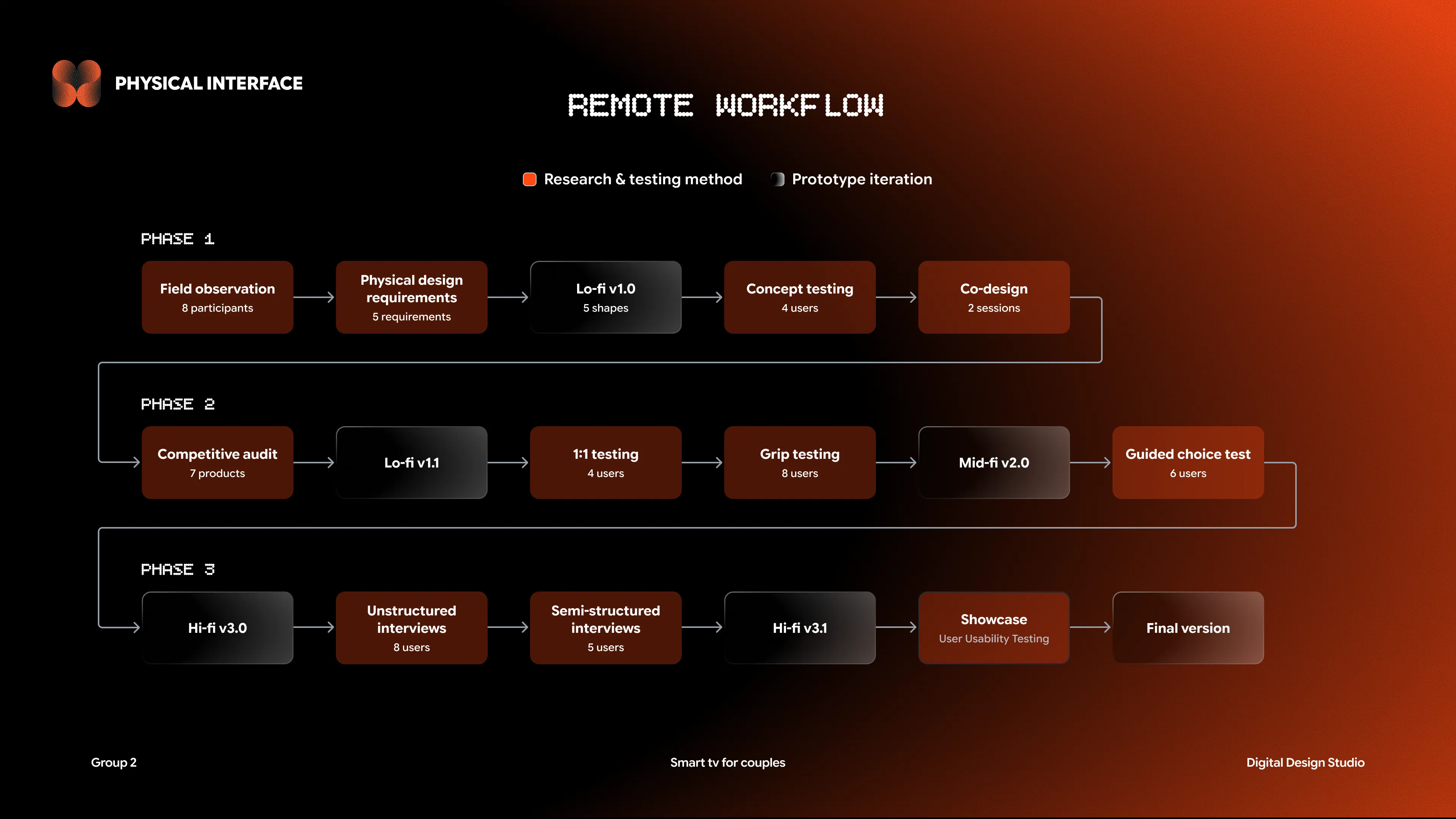
Hardware Navigation Definition (Forced-Choice Test): Forced-choice preference tests ($n=6$) ruled out joysticks (due to their protruding profile and accidental press risk) in favor of a Trackpad + Directional Arrows combination for precision and alignment with established mental models.
Digital Architecture Validation (A/B & Scenario Walkthroughs):
Menu A/B Testing ($n=6$ experts): Validated a top menu structure combined with list-tab submenus, ensuring smooth navigation without visual clutter.
Pointer Navigation and Dual Control: Tested motion-based transition (shaking the remote) to activate the onscreen pointer. Cooperative mechanics ("Dual Selection," requiring both pointers to select the same item) and a playful feature to drag the partner's cursor were introduced to turn selection deadlocks into playful interaction.
Results & Deliverables
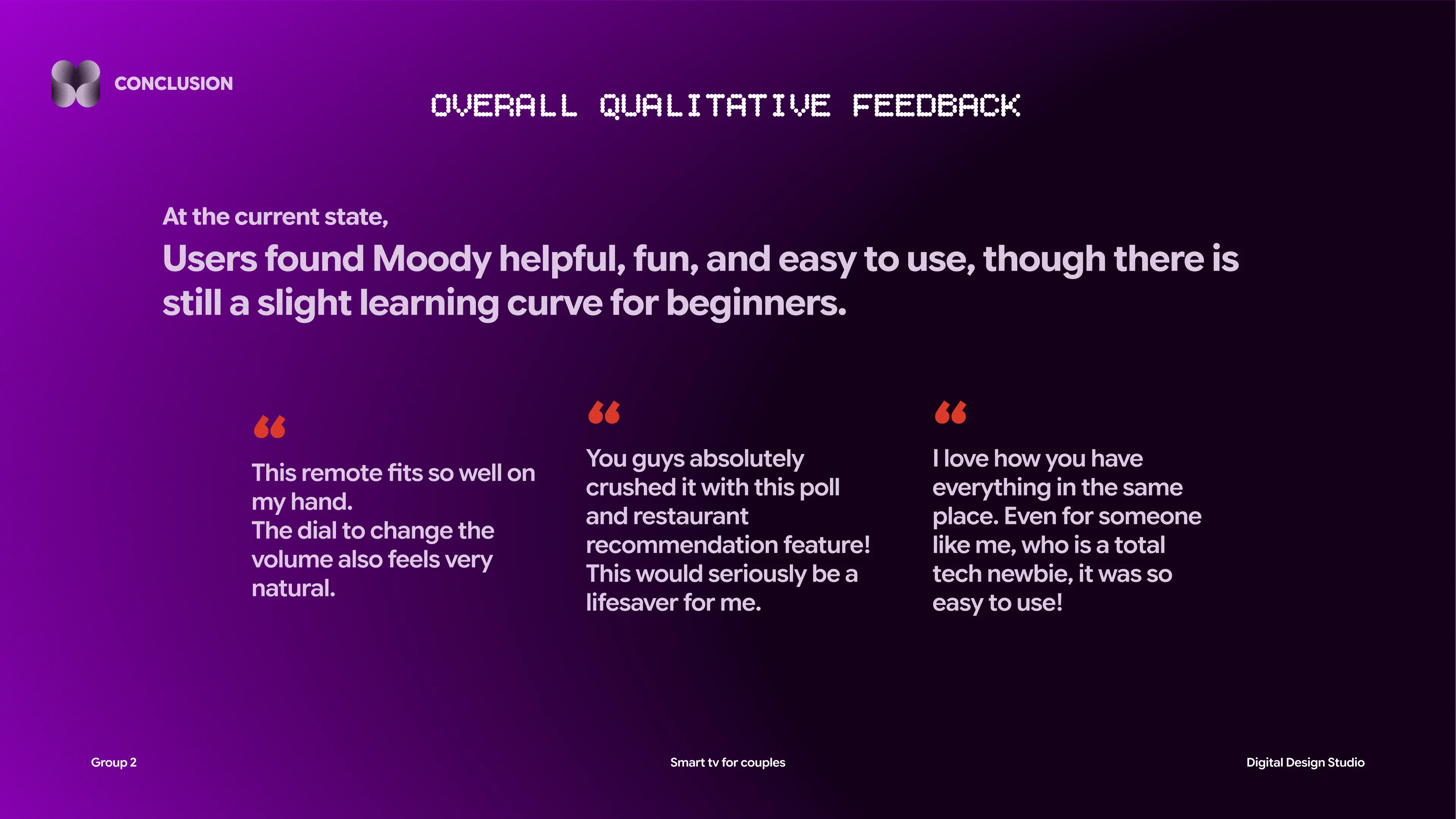
Significant Usability Increase (SUS): The final Moody system prototype achieved a 79.0/100 score on the System Usability Scale (SUS), significantly outperforming the Amazon Fire TV Stick baseline (59.5/100).
Positive Emotional Response (PrEmo): Emotional ratings of satisfaction and joy measured via PrEmo rose from 54.5% (baseline system) to 77.5% on Moody during comparable tasks.
Perceived Ease of Use (SEQ): On the Single Ease Question (SEQ), users rated the system 4.5/5, highlighting a 0-error rate and 7/7 ease score when selecting and playing a movie from the home screen.
Project Deliverables:
Digital Interface: High-fidelity prototype featuring couple dual profiles, joint recommendations (Duo Mix), group food delivery integration with polls, AI-assisted Kitchen Hub, and mode/ambient controls.
Physical Interface: Two disc-shaped remote controls with a capacitive dial, trackpad, customizable smart home buttons, pointer navigation, and a charging dock/station.
Collaborative Team Role Summary
Integrated Design Vision: Multidisciplinary execution covering the end-to-end product journey—from ethnographic research and persona mapping to integrated physical-digital testing using the Wizard of Oz technique.
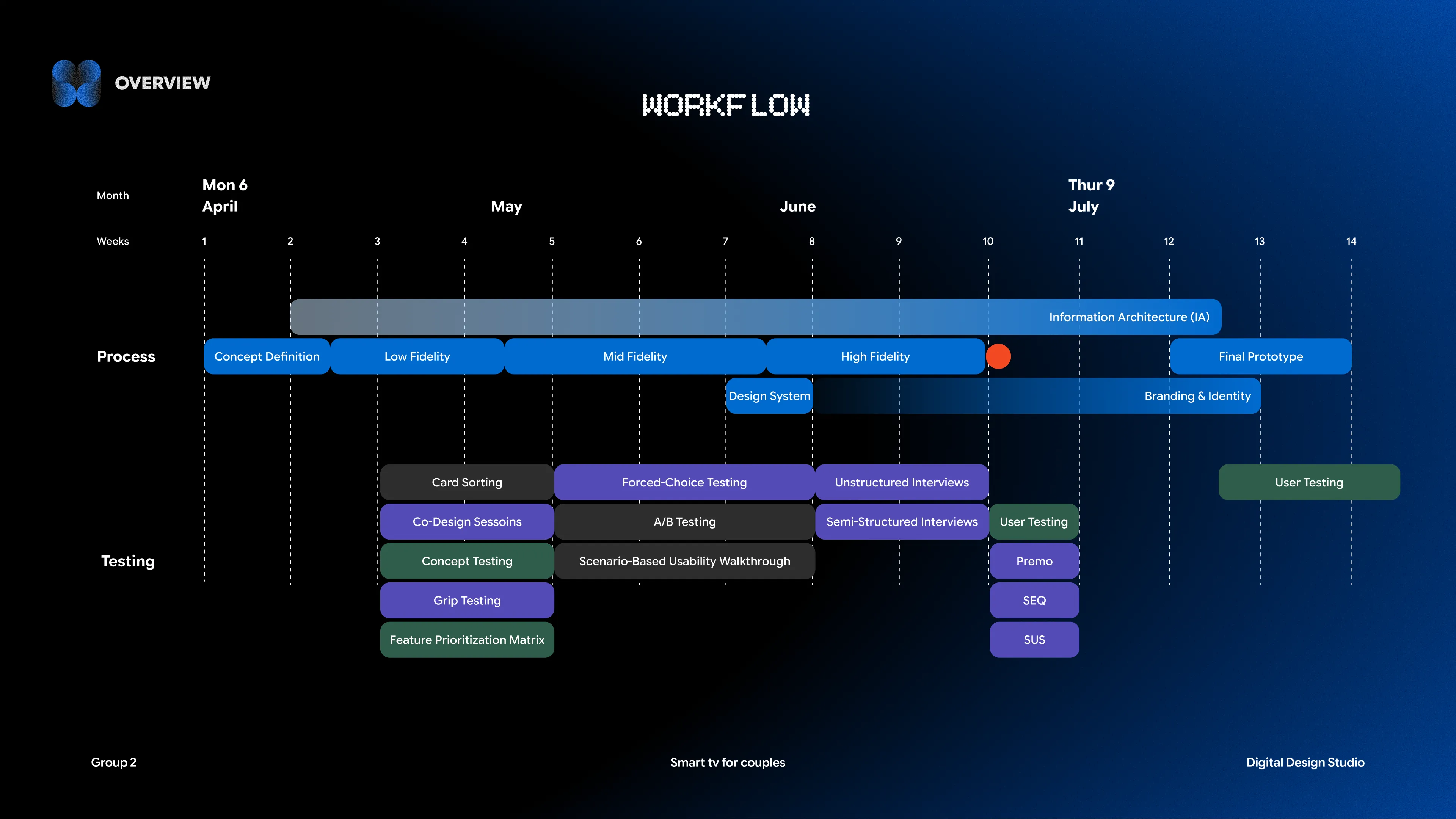
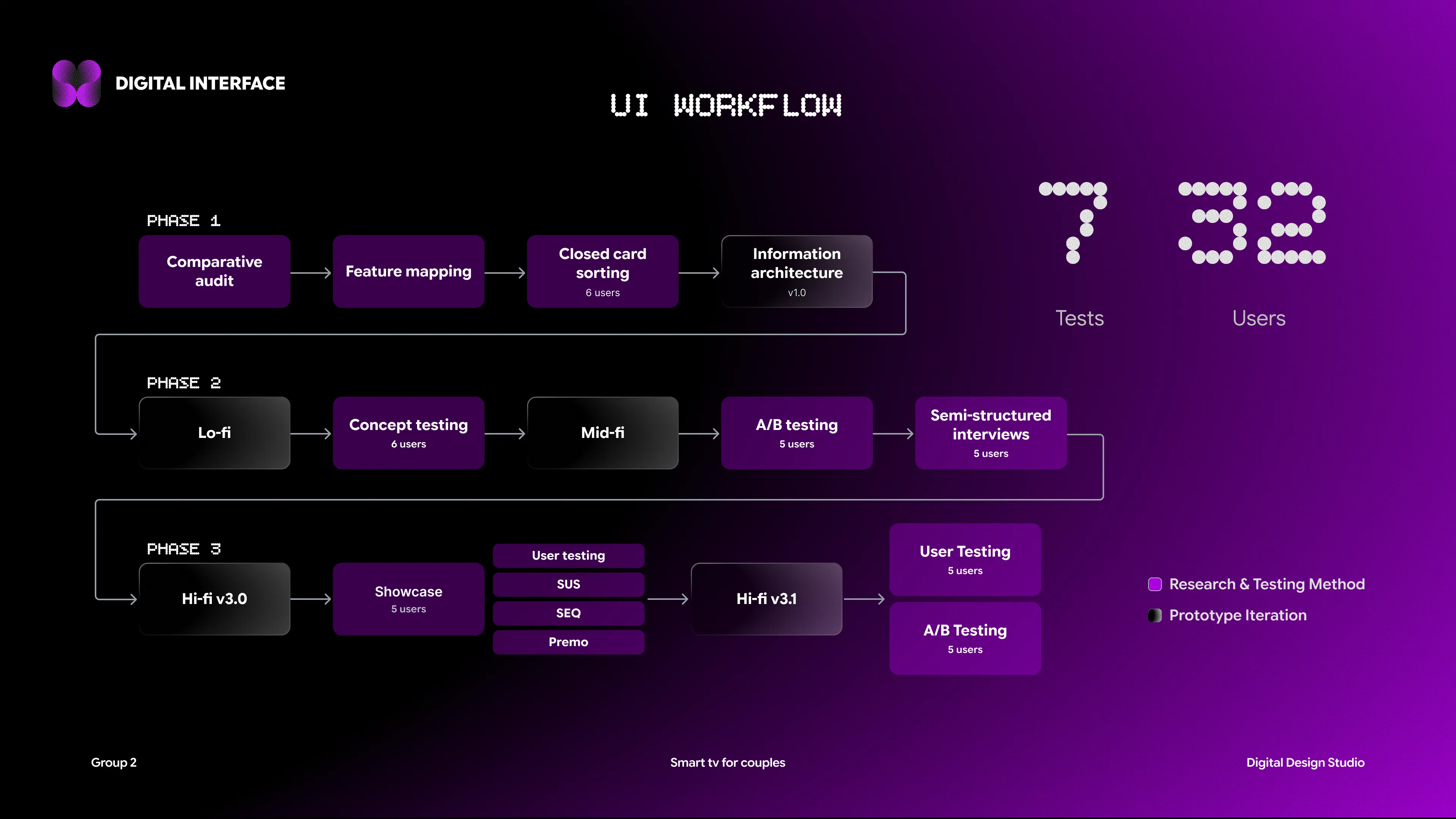
User Research & Field Testing: Conducted observational home studies, semi-structured interviews, co-design sessions, and quantitative/qualitative evaluations (SUS, PrEmo, SEQ, A/B testing, Closed Card Sorting) with the target audience (couples aged 18–35).
Digital Interface Development (UI/UX): Structured Information Architecture (IA) benchmarked against Tizen OS, webOS, and Fire TV; iterative prototyping (paper to Hi-Fi in Figma) of TV Modes (Social Mode & Kitchen Hub), split-screen dashboards, and dual profiles.
Product Engineering & Physical Prototyping: Industrial and ergonomic design of the disc remote control; grip testing, iterative clay/cardboard modeling up to final 3D-printed versions, exploring tactile micro-interactions and surface-resting usability.









Moody
Designing a Multi-User Smart TV Ecosystem A hardware-software UX ecosystem redesigning domestic TV architecture into a collaborative hub for cohabiting couples. Collaborated on the end-to-end product design process—spanning ethnographic field research, co-design, and ergonomic testing to iterative hardware-software prototyping and multi-method usability evaluations. The resulting high-fidelity system outperformed market baselines in usability and emotional engagement.
Year
2026
Client
Politecnico di Milano
Category
Physical & Digital Products
Scope
Dual-Hardware Prototyping, Ergonomic Testing, OS Information Architecture, Cross-Device Ecosystem, Usability Testing
Personal Contributions
UX/UI, UX Research, Project Manegement, Visual Communication
Impact
Achieved a 79.0 SUS score (+19.5 vs. Amazon Fire TV baseline), a 77.5% PrEmo positive emotional rating, and 0-error task success across core flows.
The Challenge
Every layer of the modern Smart TV ecosystem—from recommendation algorithms to the physical remote—is designed for a single individual. However, television viewing is the primary shared daily activity for cohabiting couples. This creates friction, asymmetric control, content negotiation deadlocks, and system blindness to group dynamics during shared household rituals.
The Solution
Moody is a holistic Smart TV ecosystem engineered around the couple as the primary user unit. Combining a dual-layer profile architecture with a tactile, disc-shaped remote control, Moody balances individual preferences, resolves content negotiation through gamified mechanics, and seamlessly transitions the TV from an active entertainment screen into a contextual background hub for cooking, dining, and hosting.
3 Big Takeaways
Dual-Layer Profiles & Collaborative Mechanics: Moody replaces single-user authentication with individual profiles that automatically blend into a shared "Duo" layer, eliminating choice paralysis through joint recommendations ("Duo Mix"), live delivery polling, and playful interactive mechanics ("Decision Game" and "Dual-Pointer Selection").
Ergonomic Surface-Resting Hardware: Grounded in field observations showing remotes spend most of their lifespans resting on furniture, the 76 mm disc-shaped remote features a concave thumb-rest, a blind-orientation lateral power button, an ambidextrous capacitive volume edge-dial, and dual-remote pointer navigation.
Contextual TV Modes Over Single-Screen TV: Testing invalidated traditional "productivity" home hubs in favor of low-prominence, ambient modes (Social Mode and AI-assisted Kitchen Hub) that embed quick smart-home presets directly into a split-screen sidebar, validated by a System Usability Scale (SUS) score jump from 59.5 (Fire TV baseline) to 79.0.